
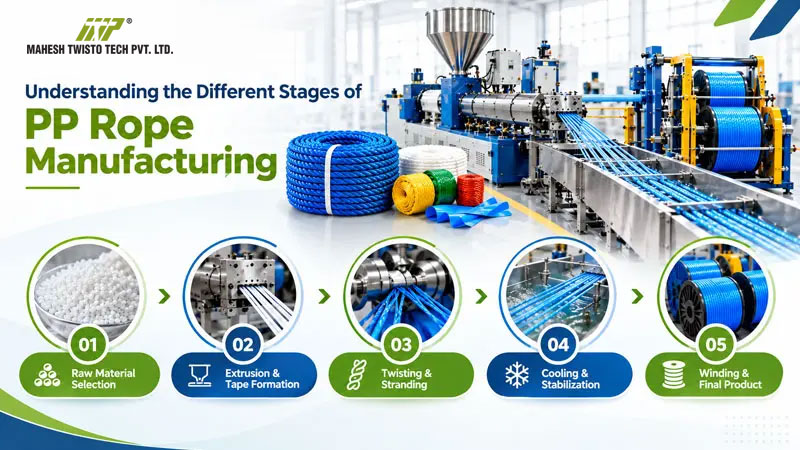
Polypropylene rope (PP rope) is extensively utilised in industries like agriculture, packaging, fishing, construction, among others. It is light, flexible and waterproof. The manufacturing of high-quality PP rope involves several processes, from the preparation of raw material to the winding of the final product.
Knowing the stages involved in producing plastic rope can help manufacturers plan their manufacturing process and even know what equipment should be used. This is where plastic rope making machine manufacturers can come in handy.
1. Raw Material Selection
The whole process starts with choosing the right polypropylene granules. The quality of the raw material is important in ensuring processing stability and quality of the end product. The raw material is screened before manufacturing to ensure it is free of any contaminants.
Selection of appropriate raw materials ensures processing stability and prevents defects in manufacturing.
2. Extrusion and Tape Formation
Polypropylene pellets are introduced into an extruder, where heat causes melting of the polymer. The molten material goes through a die, forming a sheet or film.
Cutting the sheet into narrow strips is done to make PP ropes. Constant width and thickness of the tape are crucial since irregularities may have an impact on the structure of the rope.
Mahesh Twisto Tech Pvt. Ltd. provides machines for rope production and extrusion processes. The type of equipment needed varies according to the type of rope produced.
3. Tape Stretching and Cooling
Once the tapes are made, they undergo a process where the tapes are stretched using a roller. This process ensures that the plastic is oriented and attains the characteristics that will make it into ropes.
Stretching of the tapes should not be too much, as it might lead to breaking, nor should it be too little, as it might affect the behaviour of the tapes.
4. Tape Preparation and Winding
The prepared tapes will be organised and wound onto bobbins or appropriate feeders before going into the rope-making machinery.
The uniform winding will help avoid any tangles or interruptions in the production process. The workers should also monitor the tension and feeding of the tapes.
Good preparation at this stage supports continuous operation during rope formation.
5. Twisting and Rope Formation
The twisting process joins several tapes or strands into the desired rope formation. The number of strands, twisting direction, and twists per unit length will vary depending on the rope formation and its use.
It is necessary to have proper tension to ensure uniformity in the thickness and formation of the rope. Improper tension may cause loose strands or an untidy appearance.
When choosing between plastic rope making machine manufacturers, it is wise to consider if the machines are appropriate for the desired rope diameter and construction. You can explore the mechanical, electronic and endless rope making machine ranges.
6. Winding and Finishing
After the rope has been created, it goes through the take-up process and then gets coiled or packaged into desired shapes.
Rope inspection is done by looking out for any defects or loose strands, and variations in thickness. This rope is also measured and cut into the necessary lengths.
Proper winding helps organise the final product and makes its transportation easy. See our rope coiling machines for finishing and packaging.
7. Quality Inspection
Quality checks ensure that the final product satisfies the specifications required. Several quality checks are done, including measuring the diameter, inspecting the surface, and checking for strength where applicable.
The manufacturers need to check the final product against the specifications and not just the appearance. Keeping track of production parameters is also important to identify any recurring problems.
Mahesh Twisto Tech Pvt. Ltd. manufactures machines for the rope manufacturing process. Firms need to ascertain the different configurations and technical specifications of the machines before purchase.
Conclusion
There are several stages involved in the production of PP ropes that are interconnected and include preparation of the materials, extrusion, drawing, twisting, and finishing. The strict control of each stage helps keep the quality of products and minimise problems with production.
For companies searching for plastic rope making machine manufacturers, it is important to analyse their rope varieties, their production needs, and necessary capacity. Mahesh Twisto Tech Pvt. Ltd. may be taken into consideration as well. Feel free to contact our team for more details.
FAQs
Polypropylene granules are commonly used to manufacture PP rope.
It helps orient the plastic material and prepare it for rope formation.
Equipment may include extrusion, stretching, winding and rope-making machines.
